In the previous story, The Gift of the Magi, we considered how love can mean letting go of the thing one treasures most for the sake of another person.
Today I want to share a story familiar to many Chinese families. It contains no costly gift and no dramatic, world-changing decision—only a mother who watched her child closely and repeatedly changed the environment in which the family lived.
It is the story of Mencius' mother moving three times.
What moves me is not simply that she moved home three times. It is that she understood early on that what a child sees and imitates each day—and what the child comes to regard as ordinary life—gradually becomes part of that child's development.
Far-sighted love is not controlling a child's life, nor is it simply buying more resources. It is doing our best to create an environment that supports growth, then giving the child space, clear boundaries and a growing capacity for independence.
1. Children watch—and learn—every day
According to the Biographies of Exemplary Women, Mencius lived near a cemetery as a young child. He did not understand the meaning of the funeral rites he saw. He simply watched what the adults did, then turned digging, burial mounds and ceremonial movements into games.
His mother did not scold him or merely say, “Do not copy that.” She realised that the life displayed before him every day was not the life she wanted him to regard as familiar over the long term. So she moved with him to a home near a marketplace.
The market was livelier than the cemetery. People came and went to trade; merchants called out their wares; goods moved in and out. Before long, the child began imitating merchants as they advertised and traded their goods.
Once again, his mother saw that he was always learning. But he was learning not only from books—he was learning from the patterns of life repeated before him every day.
They later moved near a school. The child began imitating rituals of courtesy, study and measured conduct with others. At last, his mother felt that this environment was better suited to his growth.
Many people remember the “three moves.” What I most want to remember is that each time, Mencius' mother paid close attention to how the environment was shaping her child.
A child's growth often begins not with understanding a principle, but with repeatedly seeing a way of life.
2. A child's true environment is more than an address
When this story is told today, many people's first thought is of buying a home in a prestigious school catchment.
A stronger school, richer resources and a safer neighbourhood can certainly form part of an educational decision. A parent's willingness to seek better conditions for a child reflects both love and responsibility.
But if we interpret the story as no more than “moving somewhere more expensive,” we make its meaning far too narrow.
The environment that shapes a child is not limited to the address on the door. It includes what the family discusses each day, how adults speak about other people, whether family members listen to one another, and whether parents blame each other in difficult moments or work together on a solution.
When a child makes a mistake, are they shamed and rejected, or helped within clear boundaries? Do parents look only at grades and outcomes, or do they also care whether the child is developing judgement, self-restraint, cooperation and responsibility?
One family may live in an excellent neighbourhood yet fill the home with anxiety, comparison and criticism. Another may not have an expensive house, but makes room for reading, respects hard work, keeps its promises, and sits down together to solve problems.
Which is the better environment for a child? The answer is not necessarily written in the value of the property.
Family values are never merely a phrase displayed on the wall. They are how the adults in a child's life actually live, day after day.
3. Creating the right environment is not deciding a child's life
Every parent wants a child to avoid unnecessary detours.
We know that the world is not always gentle, so we try to prepare more. We may have experienced scarcity ourselves, so we want to give our children better conditions. We fear seeing them hurt, and can find ourselves choosing their school, field of study, friends and even their future way of life.
But creating an environment for a child and controlling the outcome of that child's life are two different things.
Parents can prepare the soil, sunlight and water, but they cannot command every flower to grow in the same way.
Far-sighted love offers direction and space; support and boundaries.
We can teach a child that honesty matters, but we cannot make every choice on their behalf. We can set aside funds for education without demanding that the child live out a parent's imagined future. We can protect a child from risks they need not bear, but we cannot keep every storm out of their life.
Ultimately, a child does not need parents to walk the whole journey for them. The child needs to develop the ability to continue independently.
They need to understand what matters to them and accept the consequences of their choices; to have resources without becoming wholly dependent on them; to begin again after failure; and, while receiving the family's love, to respect the family's boundaries.
Love is not holding a child in our arms forever. Love is reaching the day when we can let go with confidence.
4. What a family passes on is more than resources
For many families that have created significant wealth, resources are the easiest thing to give the next generation.
Strong schools, travel, homes, capital, experience and personal networks can all open doors and help a child encounter a wider world earlier.
But a family's ability to thrive over generations depends on more than the resources it transfers. It also depends on whether values, responsibilities, rules and the capacity to create anew are carried forward.
Many entrepreneurs feel both deep affection and genuine concern for their children. They know how hard the wealth was to build, and they know their children have not walked the same path. Some respond by continually adding resources; others turn concern into excessive control.
What is truly worth passing on is not wealth alone, but the ability to create it, use it responsibly and respond to change.
Over time, a family needs to answer several questions. Why do we create wealth? Whom should it protect first? Which responsibilities must continue even when the business rises or falls? What support do we want the next generation to receive, and what responsibilities do we want them to assume?
The answers gradually shape a family's order and character. Some call this a family ethos; others express it through family letters, family meetings and long-term arrangements. The name matters less than ensuring that, when real choices must be made, the family still understands why it is choosing a particular path.
5. What can today's family “move”?
Not every family needs to change its address, and not every child needs the same kind of school.
But every family can reconsider where it directs its attention each day.
We can move from discussing only grades to asking what capabilities a child is actually acquiring; from discussing only how much money is made to asking how wealth serves the family and society; from demanding obedience to helping a child understand choice and responsibility; and from saying “I only want what is best for you” to “I am also willing to hear what you truly want.”
We can also move from avoiding conversations about illness, ageing and the future to discussing them calmly, together and in advance.
Insurance, education reserves, trusts and other planning tools can help support a family's intentions. Insurance can preserve cash flow and living choices when covered risks arise. Education reserves can reduce the chance that a crucial stage of development is disrupted by a sudden funding shortage. A trust or another arrangement suited to the family's needs may support the long-term management and use of assets for defined purposes.
But none of these tools is love itself.
They cannot replace a parent's example, a genuine relationship, or the conversations that a family has left unspoken for too long.
The purpose of planning is not to replace love with a contract. It is to ensure that love does not remain only a good intention.
6. What the three moves mean to me
To me, the most remarkable thing about Mencius' mother is not that she knew which place was “best,” but that she was willing to observe and willing to change.
Many parents are already making extraordinary efforts. We work hard, search for schools and try to give our children what we ourselves did not have. Yet sometimes we become so occupied with preparing resources that we forget to pause and ask: what is the atmosphere of this home teaching our child every day?
Good education planning is not arranging every step of a child's future.
It should hold four things in view at the same time: the capabilities the child is developing; the example the parents are setting; whether the family can sustain its educational responsibilities; and whether, if the child one day makes a different choice from the parents, we can still respect that choice and help the child accept its consequences.
The greatness of love lies not in supplying a standard answer, but in remaining willing to search together when the answer is not yet clear.
Three questions to discuss as a family tonight
First, what would we most like to have more of in our home each day, and what would we like less of?
Second, are we demonstrating through our own actions what we most often ask our children to do?
Third, twenty years from now, how do we hope our children will describe this family? Beyond wealth and resources, what do we hope they will carry with them from this home?
Choose a quiet evening and set aside grades and money. Ask both adults and children to write down: “The three things I hope this family never loses.”
When everyone has finished, do not rush to decide who is right or wrong. Take turns explaining why those three things matter.
The words that appear repeatedly may be the earliest seeds of the family's shared ethos.
Closing thoughts
A responsibility accepted today may protect one of a child's choices ten years from now. The family values shaped today may influence how grandchildren understand wealth and family thirty years from now.
True love is not writing a child's entire life in advance.
It is first recognising who a child may become, then using the real choices we make today to protect that possibility.
Parents can prepare the soil, sunlight and water, but they cannot command every flower to grow in the same way.
Love helps us see the future, and reminds us to leave room within it.
Some plans are best discussed slowly, in a quiet moment.
Frequently Asked Questions
Does the story mean a family must buy a home in a sought-after school catchment?
No. Schools and neighbourhoods are part of a child's environment, but family relationships, parental example, boundaries, reading habits and the way adults respond to problems also exert a lasting influence.
Does a good environment guarantee that a child will succeed?
No. Environment can influence the likelihood of different outcomes, but it cannot determine who a child will become. Every child retains an individual character, choices and agency.
Can setting aside education funds become a form of parental control?
Providing resources is not inherently controlling. The question is whether parents respect the child's agency and allow support to coexist with responsibility, and choice with consequences.
About the author and this series
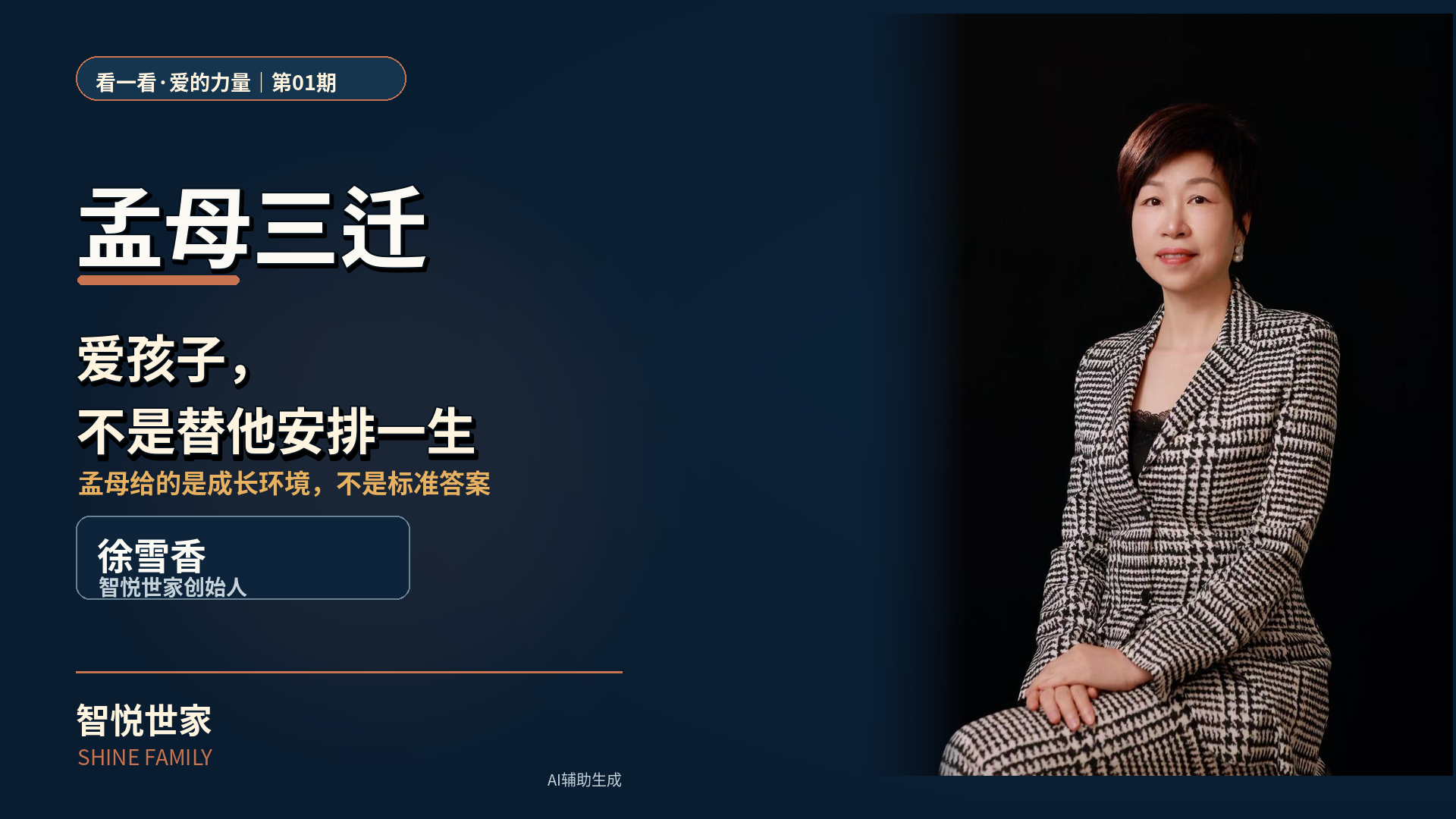
TSUI SUET HEUNG / Founder, SHINE FAMILY
She focuses on international business development, Hong Kong platforms, family protection and intergenerational legacy, with the aim of turning complex professional questions into long-term arrangements that families can understand.
Series: Previous: The Gift of the Magi | Current: Mencius' Mother Moved Three Times | Next: Love Is More Than Giving: Why Families Need to Prepare Ahead
This article was prepared with AI assistance. Its central narrative is drawn from the chapter on the mother of Mencius of Zou in the Biographies of Exemplary Women. Later embellishments are not presented as established historical fact; Mencius' later achievements are not attributed entirely to his mother; and the story is not reduced to buying property in a prestigious school catchment. Any specific arrangement involving education, insurance or trusts should reflect the family's actual circumstances and be executed by the appropriate professionals.
Full video
This two-person conversation was produced with AI assistance. Select play to watch; if your browser cannot play it directly, open the full video.
Editorial boundary: The central narrative is drawn from the chapter on the mother of Mencius of Zou in the Biographies of Exemplary Women. Later embellishments are not treated as established historical fact; Mencius' achievements are not attributed entirely to his mother; and the story is not reduced to buying property in a prestigious school catchment.