The conclusion first
Expanding overseas is not merely a matter of registering a company abroad.
What requires advance planning is how the domestic enterprise will invest abroad through a compliant ODI process, what functions a Hong Kong platform will perform, how subsidiaries in different countries will be managed, how overseas profits will arise and be repatriated, and how the family’s immigration status, education, protection and succession arrangements will keep pace as the business becomes global.
These questions may appear to belong to separate fields, but they affect one another. The equity structure determines who owns overseas projects; funding routes determine how money moves out and returns; corporate governance determines whether overseas operations can function over the long term; and family planning determines whether the founder and next generation retain options as circumstances change.
When a business genuinely goes global, therefore, it needs more than filing documents and several overseas companies. It needs a lasting master map of its global corporate structure and family arrangements.
1. Why global expansion should not begin with “register an overseas company first”
When businesses first consider overseas expansion, they often begin by choosing a country, registering a company and opening an account before moving the project forward.
Registration only creates a legal entity. It does not answer who will invest, where the funds will come from, whether Hong Kong should serve as a holding node, what business the local company will conduct, how future profits will be distributed, or what happens if the project incurs losses or exits.
Without advance answers, a company may be established only to find that its ownership is unsuitable for financing; an account may be opened before the use of funds and contracts align; or a profitable project may be forced to improvise its dividend and repatriation routes.
A sound sequence is to establish the commercial purpose and long-term objectives first, then define the relationships among the domestic entity, Hong Kong platform and project companies in each country, and finally implement the entities, accounts, contracts, authorizations and funding arrangements.
2. What ODI addresses within the overall expansion chain
ODI, or overseas direct investment, is the compliance starting point for a domestic enterprise investing abroad.
The enterprise must first explain the investment purpose, target country, amount, source of funds, ownership structure and commercial feasibility, and then work through the development and reform, commerce, banking and foreign-exchange processes applicable to the project.
ODI does not end when a filing document is issued. After filing, the enterprise must still address bank review, fund remittance, the establishment or acquisition of overseas companies, local market access, legal and tax matters, employment and environmental requirements, post-investment management and future profit repatriation.
ODI provides the compliant connection between domestic funds and an overseas investment. It is essential, but only the first step in a complete global structure.
3. Why many businesses consider a Hong Kong holding or operating platform
Hong Kong is closely connected with Mainland China and offers international finance, banking, legal, tax and professional-service resources. For enterprises with genuine cross-border operations, a Hong Kong platform may, where appropriate, perform regional holding, financing and settlement, procurement and sales, intellectual-property management or group treasury functions.
For example, a business may use a Hong Kong platform to hold subsidiaries in the Middle East, Europe, Asia and Belt and Road markets, bringing ownership, board authority, bank accounts and group reporting into a more coordinated structure.
This does not mean every business should use the same Hong Kong structure, or that all global companies should mechanically sit beneath one Hong Kong entity.
Foreign-investment access, tax-residence rules, industry licensing, partner requirements, financing arrangements and exit options differ across target countries. Some projects suit direct holding from Hong Kong, some require an intermediate regional platform, and others are better held directly by the domestic entity.
A sound structure is not one with the most layers, but one in which each layer has a genuine function, a governance rationale and proportionate cost.
4. How overseas subsidiary profits may be repatriated compliantly to Hong Kong
This is one of entrepreneurs’ greatest concerns—and one of the issues most often oversimplified.
Profits earned by an overseas company do not automatically return to Hong Kong in full and immediately merely because a Hong Kong company sits above it.
Profits must first arise genuinely in the project jurisdiction, with local accounting, audit, tax and distributable-profit requirements satisfied. Dividend and repatriation routes must then be designed lawfully in light of ownership, local foreign-exchange rules, withholding tax, treaty eligibility, bank review and board resolutions.
Service fees, interest, royalties, dividends and equity-exit proceeds each require their own commercial basis, contractual support and tax treatment. A contract inconsistent with the actual business cannot be assembled merely to move money.
Repatriation that withstands scrutiny requires the business, contracts, invoices, accounting and funds to align. Profit routes should be considered early in the investment and operating cycle, not improvised after cash has accumulated overseas.
5. Managing and redeploying funds after they reach Hong Kong
Once funds reach the Hong Kong platform, they remain corporate funds and should serve corporate purposes and group governance.
They may be retained as operating liquidity, used to repay financing, support other overseas subsidiaries or reinvest in new markets or projects. Within the company’s purpose, bank rules, tax requirements and investment authority, any treasury management or investment of corporate funds must be assessed separately by appropriately authorised institutions, with regard to liquidity, risk, governance, tax and accounting requirements.
The first question is not “what should we buy?” but whether the money is operating liquidity, strategic reserves or long-term investment capital—each with its own time horizon, risk capacity, authorization, accounting and reporting requirements.
A Hong Kong account does not remove the need to consider duration, risk, cost and corporate governance. Corporate funds must still be managed around operating and shareholder responsibilities.
6. Why corporate and family holding platforms should be separated
Corporate operating funds and long-term family assets can be planned in coordination, but should not be merged into a single account or asset pool.
An operating holding platform primarily serves corporate equity, financing, trade, profits and reinvestment. A family holding platform focuses more on long-term family assets, members’ interests, beneficial arrangements and intergenerational succession. A family office coordinates the enterprise, family and different professional institutions from a broader perspective.
The three may be planned together, but their entities, accounts, authority, accounting records and uses of funds should remain clear. The purpose is not unnecessary complexity, but to prevent operating risk from spreading to long-term family assets and family spending or personal investment from disrupting corporate financial discipline.
The corporate platform addresses how the business continues to operate; the family platform addresses how wealth is held and transferred in an orderly way. Their objectives are related, but their responsibilities differ.
7. Why family arrangements must keep pace with a global business
When a business globalizes, the company is not the only thing that changes.
The founder’s workplace, tax connections, family residence and asset structure may all change. Children may study in Hong Kong or overseas; the family may face cross-border healthcare, elder care, retirement residence and multi-currency expenses; and business equity may be spread across companies and countries.
If powers of attorney, beneficiaries, insurance, wills, trusts and succession arrangements remain confined to one jurisdiction, a health, marital, succession or liquidity event may place both the business and family under pressure.
Hong Kong status is a family option in this context, not an automatic by-product of company registration. Corporate ODI, personal immigration status, family protection and trust-based succession follow different compliance paths. Each must be assessed separately and then coordinated around long-term family objectives.
Insurance may address illness, accidents, interrupted income, retirement cash flow and responsibilities on death. Trusts may govern who manages assets, how they are distributed and long-term arrangements for minors or family members with particular needs. Family governance defines who participates in decisions, how authority is delegated and how the next generation gradually assumes responsibility.
The objective is not to accumulate tools, but to align each asset with a clearly defined family responsibility.
The first step is not another company, but a master map
A business preparing to enter several overseas markets can begin with a master map of its global corporate structure and family arrangements.
On the corporate side, list the domestic entity, Hong Kong holding company, subsidiaries in each country, investment amounts, sources of funds, business functions, profit routes and exit arrangements.
On the family side, list members’ immigration status, residence, education, protection, retirement, family holding and succession needs.
Then identify which conditions are already met, what documentation is missing and which matters require execution by banks, lawyers, accountants, tax advisers or local institutions.
Seeing the full picture first prevents later steps from conflicting. A structure’s value lies not in looking international, but in supporting real operations, governance and repatriation while enabling the entrepreneur family to live and transfer responsibility in an orderly way over the long term.
Frequently Asked Questions
1. Does every business expanding overseas need a Hong Kong holding company?
Not necessarily. The need for a Hong Kong platform depends on the actual business, target countries, market access, financing, tax, governance and exit arrangements.
2. Can all overseas profits be remitted to Hong Kong?
No absolute conclusion is possible. Repatriation depends on local distributable-profit, tax, audit and foreign-exchange requirements, bank review, board resolutions and applicable tax rules.
3. Once a company completes ODI, may the founder’s personal funds move abroad freely?
No. Corporate ODI, the entrepreneur’s personal status and funds, and family-asset arrangements are separate paths subject to their respective rules.
4. Can a Hong Kong company’s funds be treated directly as family investment capital?
They should not be conflated. Corporate funds, long-term family assets and personal living funds should have distinct entities, accounts, authority and purposes.
5. What role does a coordinated advisory gateway play?
A family office helps the entrepreneur understand the complete picture, separate responsibilities and sequence the work, coordinate corporate and family needs, and connect banking, legal, tax, insurance and other professional resources for coordinated execution.
Conclusion
Hong Kong’s value extends beyond being a place of incorporation. It may serve as a connecting platform among a business’s global ownership, cross-border capital, professional governance and an entrepreneur family’s long-term arrangements.
The business can go further when profits and capital follow clear routes; the family can move more securely when immigration status, protection and succession are orderly.
That is a more complete form of internationalization for an entrepreneur family.
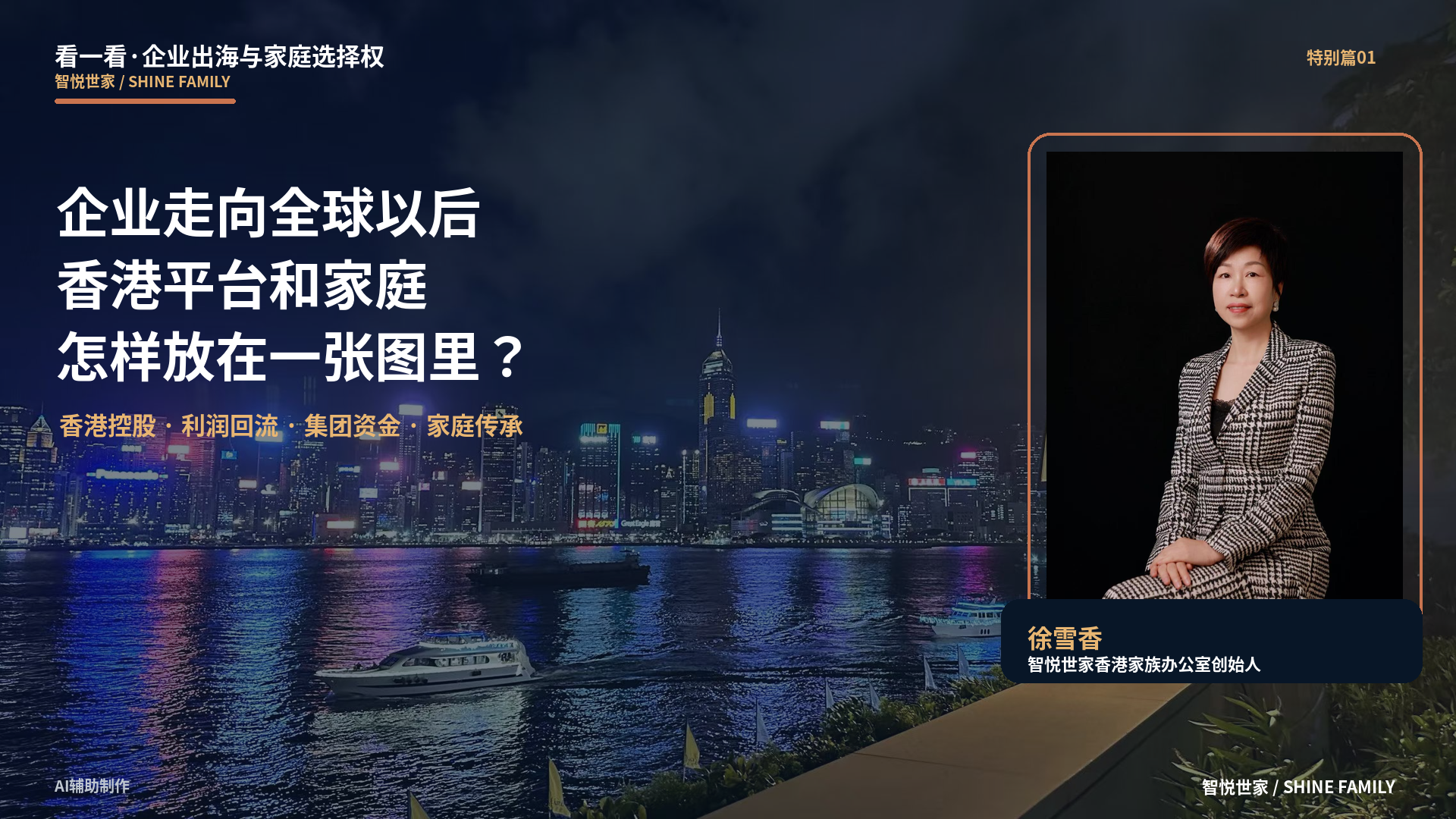
TSUI SUET HEUNG | SHINE FAMILY
This article and video were prepared with AI assistance. Specific structures, tax matters, funding routes, investment tools and immigration arrangements must be assessed individually against the enterprise’s and family’s actual circumstances.
Related Video
▶ Open video in your browserThe video does not autoplay; this page preloads only the information needed for playback. Use the button above to open it in your browser’s native player, or use the controls below.
Professional boundaries: This article provides general information and is not legal, tax, foreign-exchange, investment or immigration advice for any particular enterprise. ODI, banking, tax, legal, audit and local compliance matters must be determined by the relevant authorities and qualified professional institutions in light of the actual project.